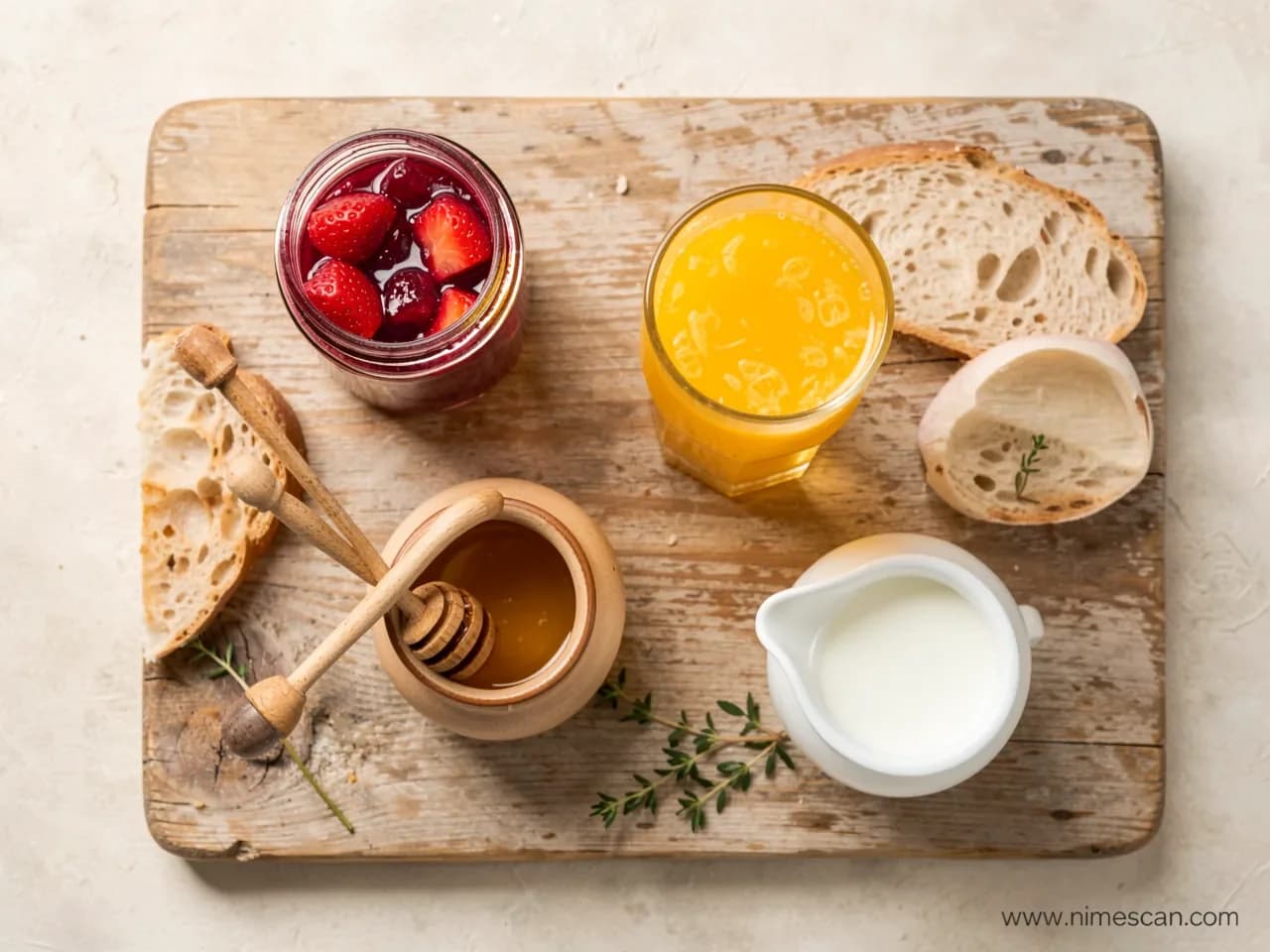
The EU breakfast aisle gets a quiet upgrade today. Directive (EU) 2024/1438 — universally called the European Breakfast Directive — applies across the bloc from 14 June 2026, the date this post is being published. It rewrites four older directives at once: the Honey Directive (2001/110/EC), the Fruit Juices Directive (2001/112/EC), the Fruit Jams Directive (2001/113/EC), and the Dehydrated Milk Directive (2001/114/EC).
The headlines: honey blends have to list every country of origin in descending order by weight. Standard jam goes from 350 grams of fruit per kilogram to 450. 100% fruit juice can now carry an explicit label saying it has only naturally occurring sugars — but the existing prohibition on added sugar in juice remains. Member states had until 14 December 2025 to transpose the rules into national law; the practical compliance date is today.
Here's what's actually changing across the four breakfast categories, what's driving it, and what it means for what's in your fridge.
What is the European Breakfast Directive?
The four amended directives all date from 2001 and have been showing their age. Each governed a category of product common at the breakfast table — honey, fruit juice, jam, dehydrated milk — and each had labelling and composition rules that were broadly consumer-friendly but increasingly out of step with two trends: rising rates of adulteration in international supply chains (particularly for honey), and increasing consumer demand for clearer information about sugar content (particularly for juice and jam).
Directive (EU) 2024/1438 was adopted in May 2024 with three explicit goals: improve transparency about the origin and composition of these products, raise minimum quality standards (specifically the fruit content of jams), and align with the EU's Farm to Fork strategy on healthier diets and reduced added sugar.
The directive doesn't replace existing food labelling regulations — it sits alongside Regulation (EU) No 1169/2011 on the provision of food information to consumers and the contaminants regulation we covered in the BPA and PFAS packaging post. It targets the four breakfast categories specifically.
What changes for honey
The honey amendment is the most consumer-visible change.
Country of origin for every honey in a blend. Before today, EU rules allowed honey blends to be labelled with vague phrases such as "blend of EU honeys," "blend of non-EU honeys," or "blend of EU and non-EU honeys." A jar containing honey from five countries could be sold without naming any of them. From 14 June 2026, honey blends must list each country of origin in descending order by weight, regardless of how many countries are involved. A jar containing 40% Spanish honey, 30% Ukrainian honey, and 30% Chinese honey will say so on the label.
Adulteration enforcement. Recent investigations found that 46% of honey imports tested at EU borders showed signs of adulteration — most commonly dilution with sugar syrup from rice, corn, or sugar beet. The directive empowers the Commission to set up an EU-wide traceability system and a reference laboratory specifically for honey adulteration detection. Member states are required to designate national reference laboratories that report into the EU system. This is enforcement infrastructure, not a consumer-facing change, but it's the reason the origin labelling matters: without it, "country of origin" is just a claim.
National producer protection. Several member states had introduced national-level origin rules in advance of the EU directive — France and Italy notably required country-by-country listing on honey blends earlier. The EU rules now harmonise that across the bloc, and national rules that go further (such as requiring a specific font size for origin information) remain valid.
What changes for jam and marmalade
The jam amendment is the biggest composition change in the directive.
Minimum fruit content rises sharply. Under the original 2001 directive, standard "jam" had to contain at least 350 grams of fruit per kilogram of finished product. "Extra jam" required 450 grams. "Marmalade" — which under EU rules refers exclusively to preserves made from citrus fruit — required 200 grams of citrus per kilogram. Under the new rules, those thresholds become:
- Standard jam: 450 g/kg (up from 350)
- Extra jam: 500 g/kg (up from 450)
- Marmalade: 250 g/kg (up from 200)
The increase closes a long-standing gap where standard EU jam could legally be more sugar than fruit by weight. A 450 g/kg minimum still leaves substantial room for added sugar, but the centre of gravity shifts. Member states can grant their producers a transition period until 16 June 2030 to reformulate, so on-shelf compliance will be gradual rather than immediate.
Reduced-sugar designation. The directive also recognises "reduced-sugar jam" as a category for products with at least 30% less sugar than standard jam, similar to the reduced-sugar juice category below. This is a labelling category, not a composition mandate — producers can choose whether to make and market reduced-sugar versions.
What changes for fruit juice
The juice amendment is the most relevant to current consumer-information debates around sugar.
"Contains only naturally occurring sugars" claim allowed. From 14 June 2026, 100% fruit juice in the EU can carry an explicit label stating that it "contains only naturally occurring sugars," to help shoppers distinguish it from nectars (typically 25–50% juice, plus added sugar and water) and fruit-juice drinks (lower juice content, often heavily sweetened). The claim is restricted to actual juice — nectars and drinks cannot use it.
Reduced-sugar juice category. The directive defines "reduced-sugar fruit juice" as juice that has had at least 30% of its natural sugar content removed through specific physical or enzymatic processes. This is intended to give producers a regulated alternative to juice-based drinks for the sugar-conscious market.
No added sugar in juice still applies. A frequently asked question worth being clear on: the prohibition on added sugar in products labelled simply "fruit juice" has been in place since the 2012 amendment of the 2001 directive and remains in force. The new directive doesn't loosen that. Added sugar is still permitted in nectars and fruit drinks, which is why the label distinction matters more than ever.
Vitamins and minerals. Fruit juice producers can now add specified vitamins and minerals to juice under conditions set out in Regulation (EC) No 1925/2006 — previously, fortification of juice was more restricted. Producers don't have to fortify, but if they do they have to label clearly.
What changes for milk and dairy
The dehydrated milk amendment is narrower than the other three.
The directive tightens labelling around dehydrated milk products — milk powders, evaporated milk, condensed milk — to clarify which physical processes have been used and what residual fat and protein levels are. It also formalises that products marketed under one of the protected dehydrated-milk names must conform to the corresponding specifications, closing a loophole where novel processing methods could produce products in a regulatory grey zone.
For most retail shoppers, the visible change is minimal. The effect is mostly upstream — in ready meals, baked goods, infant formula precursors, and other categories that use dehydrated milk as an ingredient.
Why is the EU doing this?
The Breakfast Directive sits in a broader pattern of EU food regulation tightening since 2023. The drivers:
- Adulteration of imported food has become a serious enforcement concern, particularly for honey. The 2023 EU-wide testing finding that 46% of honey imports showed signs of adulteration was a triggering data point.
- Farm to Fork — the EU's stated strategy for healthier and more transparent food systems — explicitly includes minimum-quality-standards updates as a workstream. Higher jam fruit content and clearer juice labelling both fit that.
- Consumer demand for clearer sugar information has driven several national-level initiatives in member states. The EU directive harmonises and to some degree gets ahead of national divergence.
- Trade negotiations — clearer EU labelling and traceability rules give the bloc a stronger position when negotiating equivalence with non-EU exporters, particularly post-Brexit and ahead of the renegotiated EU-UK sanitary and phytosanitary agreement.
The directive doesn't ban any product category. It changes what producers have to disclose and what minimum compositions they have to meet to use specific product names.
What it means for shoppers
Today is the practical change date, but the on-shelf reality will take some months to settle. Products manufactured before today and already in the supply chain can still be sold under their existing labels. From-now-on production has to comply. Honey is the category where you'll notice the change first — origin labels will become much more specific over the next few months as importers re-label. Jam reformulation will be slower because of the 2030 transition window. Juice labelling claims are optional and will appear as producers choose to use them.
Related: The EU BPA and PFAS Packaging Ban: What Changes in 2026 — a different angle on the same EU food-regulation pipeline, focused on what's outside the food itself. The New Nutri-Score Algorithm for 2026 — what the major reformulation looks like at the labelling layer.
How Nime treats the breakfast categories
Nime's score for honey, jam, juice, and milk products incorporates the new labelling and composition rules where they affect a product directly. Honey origin information feeds into the per-product detail view. Jam fruit content is captured per product where the manufacturer discloses it. Juice products are classified as juice, nectar, or fruit-juice drink based on the labelling rules above — the "contains only naturally occurring sugars" status is reflected in the score for products that qualify. The full breakdown of how each input is weighted is on the methodology page.
Frequently asked questions
What is the European Breakfast Directive?
It's Directive (EU) 2024/1438, which amends four older breakfast-product directives at once — covering honey, fruit juice, fruit jams and similar preserves, and dehydrated milk. EU member states had to transpose it into national law by 14 December 2025, and the new rules apply across the bloc from 14 June 2026. The amendments tighten labelling, raise minimum fruit content in jams, change how fruit juices can describe their sugar content, and require clearer honey origin and traceability. The name comes from the fact that all four product categories are common breakfast staples.
What changes for honey on 14 June 2026?
Honey blends sold in the EU must now list the country of origin of every constituent honey on the label, in descending order by weight, regardless of how many countries are involved. The previous rules allowed vague labels such as "blend of EU and non-EU honeys." The new rules also empower the Commission to set up a traceability system and a reference laboratory to detect adulteration — both have been ongoing concerns, particularly around sugar syrup adulteration of imported honey. The combined effect: shoppers see clearer origin information, and regulators get better tools to enforce it.
What changes for jam and marmalade?
The minimum fruit content in standard jam increases from 350 grams of fruit per kilogram of finished product to 450 grams. For "extra jam" the minimum rises from 450 to 500 grams. Marmalade (which under EU rules can only refer to citrus-based products) sees its minimum fruit content increase from 200 to 250 grams. Member states can grant a transition period until 16 June 2030 for producers to meet the new thresholds. The change closes a long-standing gap where standard EU jam could legally be more sugar than fruit by weight.
What changes for fruit juice?
The most visible change is that 100% fruit juice can now carry a label explicitly stating that it "contains only naturally occurring sugars," to help consumers distinguish it from nectars and other fruit-based drinks that have added sugar. The new directive also introduces "reduced-sugar fruit juice" as a defined category (at least 30% less sugar than standard), allows fruit juice producers to add vitamins and minerals under specific conditions, and clarifies labelling for juices made from concentrate. The change does not allow added sugar in juices labelled simply "fruit juice" — that prohibition has been in place since 2012 and remains.
How does this affect shoppers outside the EU breakfast aisle?
The directive directly governs four product categories, but its effects ripple wider. Branded breakfast cereals, yogurts with fruit, baked goods, and ready meals often use jam, juice concentrate, honey, or milk powder as ingredients — the upstream rules change what those ingredients contain. Cereals advertised as "with real fruit jam" will be using jam that is now at least 450 g/kg fruit by weight rather than 350. Yogurts advertised with "a touch of honey" are using honey with traceable origin. The labelling change for juices doesn't extend to nectars or fruit-juice drinks, so the distinction between "juice" and "drink" on the carton matters more than before.
Sources: Directive (EU) 2024/1438 — full text on EUR-Lex; European Commission — Breakfast Directives labelling rules; Browne Jacobson — European Breakfast Directive insights; European Commission — Farm to Fork strategy; Honey Directive (2001/110/EC) — original text; Fruit Juices Directive (2001/112/EC) — original text; Fruit Jams Directive (2001/113/EC) — original text; Dehydrated Milk Directive (2001/114/EC) — original text; Regulation (EU) No 1169/2011 on the provision of food information to consumers; Regulation (EC) No 1925/2006 on the addition of vitamins and minerals to food; Food Safety News — EU honey adulteration investigation.