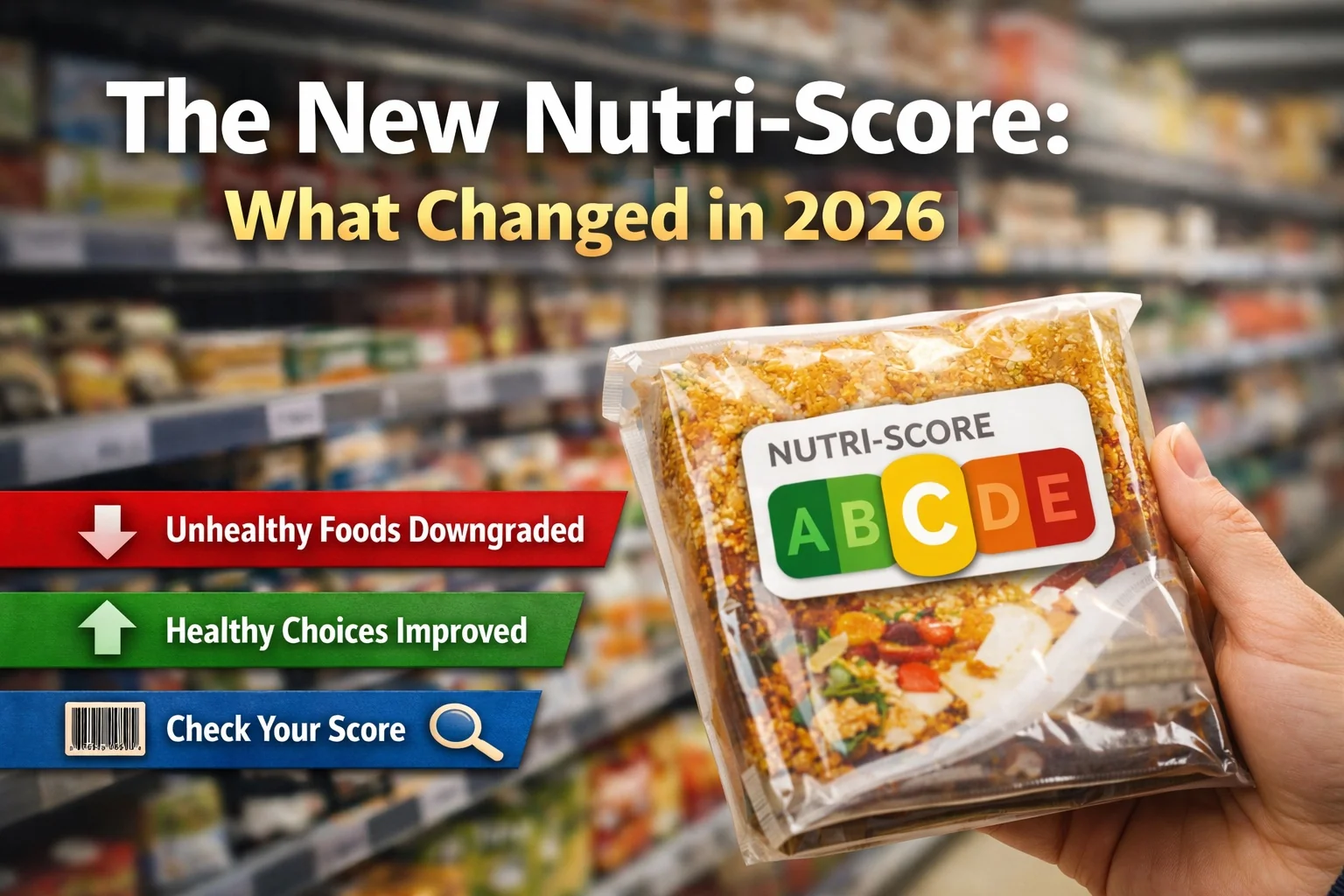
The new Nutri-Score is now fully live across Europe. As of January 2026, the updated algorithm applies to every pre-packaged food sold in the seven countries that use the label — and if you've noticed your favourite breakfast cereal or drinkable yoghurt suddenly showing a different colour, that's why. Between 30% and 40% of products carry a different score than they did under the old system, according to the Nutri-Score Scientific Committee.
This post walks through what actually changed in the 2026 update, which everyday products ended up with worse (or better) scores, whether Nutri-Score is about to become mandatory across Europe, and how to check any product in seconds.
What is the new Nutri-Score?
The new Nutri-Score is an updated version of the A-to-E front-of-pack label used across seven European countries, revised to rate foods more strictly on sugar, salt, and sweeteners while rewarding fibre, unsaturated fats, and whole grains. The updated algorithm first came into force on 1 January 2024 for new products, with a two-year transition period for existing stock that ended in January 2026 — which is why most shoppers are only now seeing the change on shelves.
The label itself hasn't changed visually. It's still a five-letter, five-colour scale from a dark-green A (best) to a dark-red E (worst). What changed is the maths behind the letter.
Why the algorithm was updated
The revision was led by an independent Scientific Committee drawing on experts from the seven countries that use Nutri-Score: Belgium, France, Germany, Luxembourg, the Netherlands, Spain, and Switzerland. The committee concluded the original 2017 algorithm worked well overall but missed important distinctions — like separating whole-grain bread from refined white bread, or olive oil from highly refined cooking oils. The update tightens those distinctions and aligns the label more closely with European dietary guidelines.
Which products got downgraded under the new Nutri-Score?
Sugary drinks, salty snacks, ready meals, and sweetened dairy products took the biggest hits in the 2026 update. The consumer watchdog foodwatch ran a market check in January 2026 and flagged several revealing examples:
- Nesquik cocoa powder (prepared with low-fat milk) moved from a green score to orange. Sugary milk-based drinks are now rated more strictly under the beverage algorithm.
- Yfood drinkable meals dropped from A all the way to E. Anything consumed as a drink now runs through the beverage algorithm, which is stricter than the general-food one. Milk-based meal replacements were previously classed as food.
- Dr. Oetker pizzas and similar ready meals fell into the yellow-to-red range. The new algorithm penalises high salt and sugar more aggressively, and the thresholds for fibre and protein to count positively have moved up.
- Cornflakes shifted from green to orange for the same reason.
- Crisps went from a C to a D, driven mainly by salt content.
- Artificially sweetened drinks previously scored a light-green B thanks to "no sugar, no calories." The new algorithm factors in non-sugar sweeteners, so many have dropped to C or lower.
If one of your regular buys looks worse than you remember, this is almost certainly why.
Which products improved?
Olive oil, whole-grain breads, and fatty fish all came out better under the 2026 algorithm. The committee specifically wanted the label to flag ingredients central to the Mediterranean diet more clearly.
- Olive oil moved up to a light-green B. Under the new rules, vegetable oils are rated on the ratio of unsaturated to saturated fatty acids, which favours olive, rapeseed, and walnut oils over palm and coconut. Butter, by contrast, is still an E.
- Whole-grain breads are now better separated from refined-flour breads. To get a positive score, a product needs meaningfully more fibre than before.
- Fatty fish like salmon and mackerel are classified more favourably.
- Nuts and seeds moved into a revised "fats, oils, nuts and seeds" category with updated positive scoring.
How the 2026 Nutri-Score changes affect your weekly shop
The practical upshot: a Nutri-Score from 2023 is not comparable to one from 2026 — even on the same product.
During the transition window, the same brand could appear on shelves with two different letter grades, depending on when the packaging was printed. Regulators allowed companies to sell through old stock, so you might still spot a dated label in the coming months. Some manufacturers have added a small banner next to the logo indicating the updated formula was used, but it isn't required.
What to actually do about it:
- Trust the newer label when you see both versions side by side.
- Don't assume your past "A" favourites are still As, especially in sugary drinks, ready meals, and flavoured dairy.
- When in doubt, scan the barcode to pull up the most current score.
It's also worth remembering that Nutri-Score rates products relative to others in the same category, not in absolute terms. A Nutri-Score B pizza is better than a D pizza, but a pizza is still a pizza.
Related: What's actually in your protein bar? The 2026 reality — a case study in how the new algorithm interacts with ultra-processed product categories.
Is Nutri-Score becoming mandatory across Europe?
Nutri-Score is still voluntary across the EU, but France has moved to make it mandatory nationally — and the decision is likely to pressure other countries. On 7 November 2025, the French National Assembly voted to require Nutri-Score on all pre-packaged foods as part of the 2026 social security budget law, with targeted exemptions for protected-designation products such as PDO, PGI, Label Rouge, and organic. The exact implementation timeline will be set by decree.
Separately, the European Commission quietly dropped plans for an EU-wide mandatory front-of-pack label in 2025, leaving the decision to individual member states. Consumer groups like foodwatch continue to push for EU-level harmonisation, arguing that voluntary adoption lets manufacturers with the worst products simply opt out — which is exactly what many of them have done.
For shoppers, the short-term upshot is simple: if a product doesn't display a Nutri-Score, that absence is itself a signal worth paying attention to.
Related: BPA and PFAS banned: the 2026 EU packaging crackdown — the EU's other major 2026 food-labelling shift, on packaging chemistry rather than nutrition.
How to check a product's new Nutri-Score
The fastest way to see a product's current Nutri-Score is to scan its barcode with a food app that updates its database in real time. Tools like Nime pull the latest algorithm directly, so you see the correct 2026 score regardless of what's printed on the pack — which matters during the transition, when old stock may still display out-of-date grades.
Scanning is especially useful when:
- A product doesn't display a Nutri-Score on the packaging at all (many premium or imported brands skip it).
- You want to compare two options side by side in the shop.
- You want to see why a product got its score — the sugar, salt, fibre, and additive breakdown.
A food scanner like Nime also goes beyond Nutri-Score alone, flagging specific ingredients shoppers may want to avoid — additives, allergens, controversial sweeteners — that don't factor into the letter grade itself.
See also: How Nime scores products — additive risk, microplastic exposure, and personalised health goals on top of Nutri-Score.
How Nime relates to Nutri-Score
Nime is not derived from Nutri-Score. Nime's Harmfulness score is independently calculated and is not affiliated with, or endorsed by, the Nutri-Score Scientific Committee or any participating national authority. The two systems measure different things: Nutri-Score grades nutritional profile (energy, sugar, salt, fibre, etc.) on an A–E colour scale; Nime's Harmfulness score weights additives, ultra-processed level, pesticide exposure, and microplastics into a 0–100 number where lower indicates lower modelled risk. A product can score well on one and poorly on the other.
Frequently Asked Questions
When did the new Nutri-Score come into effect?
The updated algorithm applied to new products placed on the market from 1 January 2024. A two-year transition period allowed existing stock to sell through, ending in January 2026. From 2026 onward, almost every Nutri-Score on the shelf reflects the new formula.
Which countries use Nutri-Score?
Seven European countries have officially adopted Nutri-Score: Belgium, France, Germany, Luxembourg, the Netherlands, Spain, and Switzerland. It remains voluntary in all of them, though France voted in November 2025 to make display mandatory nationally.
Why did my favourite product get a worse score?
The new algorithm is stricter on sugar, salt, and non-sugar sweeteners, and it raised the thresholds for fibre and protein to count as positives. It also moved all drinkable products — including flavoured milk and meal-replacement shakes — to the stricter beverage algorithm. If your product falls into any of those categories, a drop is likely.
Does Nutri-Score account for food additives?
No. Nutri-Score rates nutritional profile — calories, fats, sugar, salt, fibre, protein, and a few positive ingredients — but it doesn't flag specific additives, colourings, or preservatives. For that, you need an app that reads the full ingredient list.
How is Nutri-Score different from a food scanner app?
Nutri-Score gives you one overall letter grade based on nutritional profile. A food scanner app reads the full ingredient list and can flag specific concerns — additives, sweeteners, allergens, palm oil — that don't factor into the letter grade. The two complement each other: use the score for a quick at-a-glance take, and the ingredient breakdown when you want to know exactly what's in the pack.
Sources: Nutri-Score Scientific Committee via Santé publique France; foodwatch market check, January 2026; French National Assembly, 7 November 2025 vote on the 2026 PLFSS; European Commission.