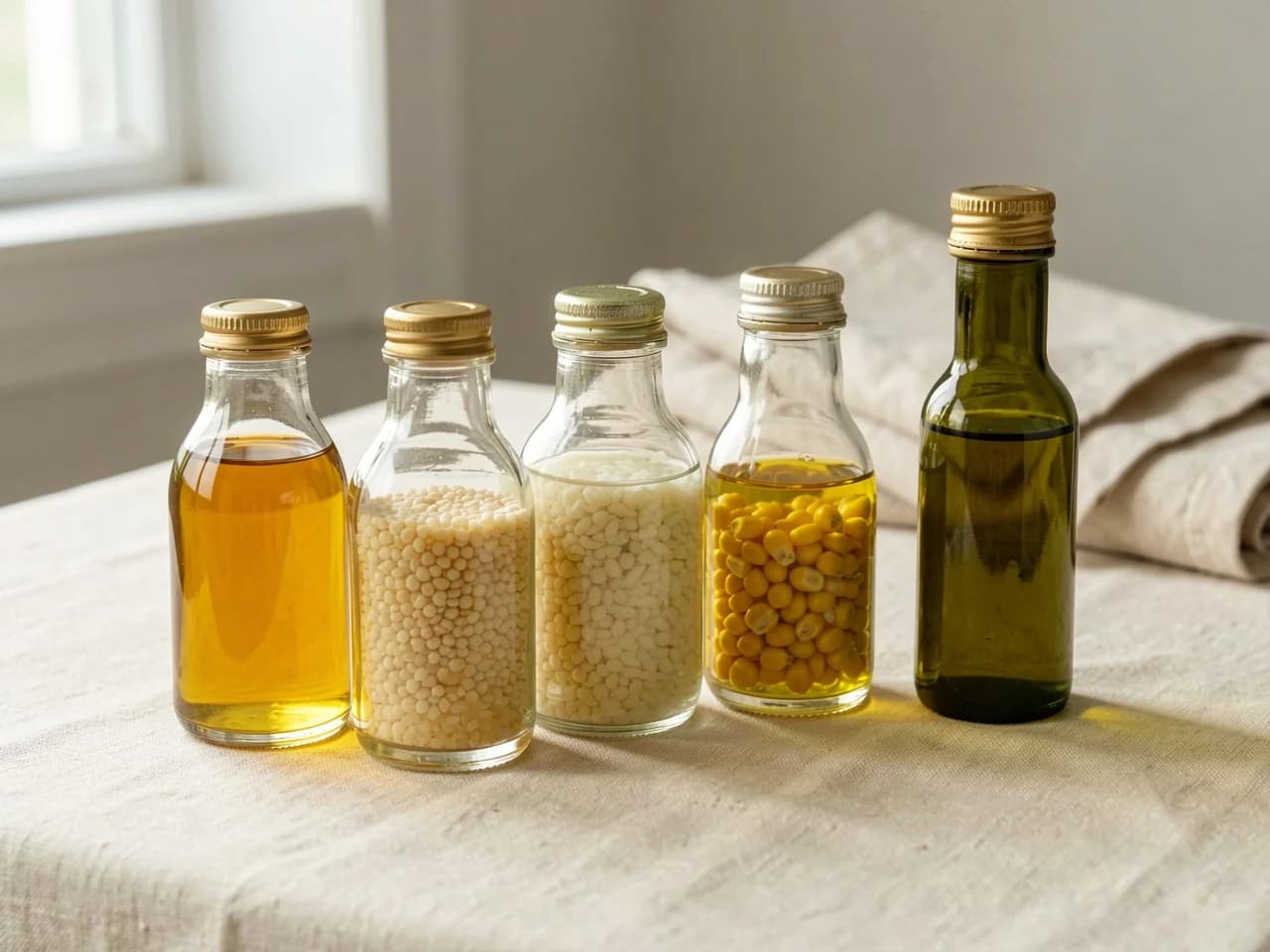
The seed-oil panic has been one of the dominant food conversations of the past three years. On TikTok, Substack, podcasts, and wellness Instagram, the message has been remarkably consistent: seed oils are toxic, they cause inflammation, they're behind the rise in chronic disease, and switching to butter or olive oil is one of the most important health moves you can make.
Several things about that consensus are true. Some are not. And the gap between what the wellness internet says and what the peer-reviewed research has found over the past 18 months has become large enough that it's worth working through carefully.
This isn't a defence of ultra-processed food. The criticism of food categories that happen to contain industrial seed oils — fried fast food, packaged snacks, deep-fried takeaway, ultra-processed convenience products — remains valid. What's not holding up is the specific causal claim that the seed oils themselves are the active harm, and that swapping them for other fats meaningfully changes health outcomes. Here's what the recent evidence actually shows.
What seed oils are, and what people are arguing about
The "seed oil" category in wellness discussion usually covers commonly used vegetable oils extracted from the seeds of plants: sunflower, safflower, soybean, corn, canola (rapeseed), and cottonseed are the main examples. They're high in polyunsaturated fats, particularly linoleic acid — an essential omega-6 fatty acid the body cannot produce on its own.
The criticism centres on three claims:
- Linoleic acid drives inflammation in the body, because it converts to arachidonic acid, which is an inflammatory precursor.
- Industrial extraction and refining introduces oxidised compounds, heat damage, and trace solvents that compound the harm.
- The shift from animal fats to seed oils in the post-war Western diet correlates with the rise of cardiovascular disease, obesity, and chronic inflammation.
The first claim is mechanistic. The second is about processing chemistry. The third is correlational. All three have been pulled into a single internet-grade narrative — "seed oils are killing us" — that's much more confident than any one of them justifies individually.
What the 2025–2026 research actually found
Three lines of recent evidence have moved the conversation:
The 1,894-person blood marker study (June 2025). Researchers measured plasma linoleic acid levels against ten inflammatory biomarkers across nearly 1,900 adults. The result, summarised in coverage on ScienceDaily and analysed in detail by OmegaQuant: higher linoleic acid was associated with lower inflammation markers, not higher. None of the omega-6 polyunsaturated fatty acids tested showed a significant positive association with any of the ten inflammatory biomarkers measured. The authors concluded the findings do not support the claim that omega-6 fatty acids are pro-inflammatory at typical dietary intake levels.
The controlled-trial review. A systematic look at controlled-feeding studies in which participants were assigned diets with varying levels of linoleic acid found, as summarised by foodfacts.org, that not a single trial demonstrated convincing evidence that seed oils increase inflammation. Three of the trials actually found anti-inflammatory effects from higher seed oil intake.
The type 2 diabetes association. Adults with the highest plasma linoleic acid levels in the same blood marker work had a 35% lower risk of developing type 2 diabetes over follow-up compared to those with the lowest levels.
The arachidonic-acid conversion question — the mechanistic claim that anchors much of the seed-oil critique — has also been re-examined. The published conversion rate from dietary linoleic acid to arachidonic acid is approximately 0.2%, far too low to drive the body-wide inflammatory effects the popular narrative posits.
The clearest summaries of all of this for non-specialist readers come from Johns Hopkins Bloomberg School of Public Health, Memorial Sloan Kettering Cancer Center, and EUFIC. All three landed on roughly the same conclusion: the available evidence does not support the popular claim that seed oils are inflammatory or uniquely harmful at typical intake levels.
Related: Emulsifiers in Food: What the Research Actually Says — a different example of how observational research evolves and where the calm middle of the evidence often sits.
Why does the public conversation look so different from the science?
A few reasons stack, and none of them are dismissive of the people raising the concern.
The cleanest explanation is observational versus causal confusion. Seed oils are heavily present in ultra-processed food. Ultra-processed food is reliably associated with worse health outcomes across a wide range of endpoints. The wellness-internet narrative compresses those two findings into "seed oils cause the bad outcomes" — but the same association would show up for any common ingredient in the same category. The active harm in ultra-processed food appears to be the processing depth itself: the additive density, the energy density, the hyperpalatability engineering, the displacement of less-processed alternatives in the diet. Seed oils are correlated with that pattern; they don't drive it.
A second reason is media incentives. A simple, share-friendly food villain travels further on social media than a nuanced research summary. "Seed oils are toxic" is a 4-word claim that fits a 15-second video. "The available evidence on linoleic acid does not support the inflammatory claim at typical intake levels, while ultra-processed food remains a separate and well-supported concern" is a 32-word claim that does not.
A third reason is older mechanistic theories that have been overtaken by direct human evidence. The arachidonic acid conversion argument was a plausible mechanism in the 1990s; the controlled trials of the 2020s have found the conversion rate too low to drive the effects the theory predicted.
A fourth reason worth naming: legitimate distrust of industrial food production that gets attached to seed oils because they're one of the visible markers of it. That distrust isn't irrational and isn't well-served by being told "seed oils are fine." The honest framing is that industrial food processing is worth taking seriously and that the specific seed-oil claim isn't where the evidence is.
What does this mean for cooking?
Practical heuristics consistent with the current evidence:
- Choose cooking fats based on the cooking application and your taste preferences. Olive oil for moderate-heat sautés and dressings. Higher-smoke-point oils (refined seed oils, avocado oil) for higher-heat cooking. Butter or ghee where the flavour earns its calories. None of these choices is the difference between health and harm.
- The fat in the pan is a much smaller question than the food in the pan. Whether your meal is broadly built around whole produce, whole grains, fish or legumes, and minimally processed dairy or meat matters more than whether you cooked it in canola or olive oil.
- Watch out for inflammation-claims that hinge on a single ingredient. Both "seed oils cause inflammation" and "seed oils prevent inflammation" are over-simplifications. The underlying research keeps finding that overall dietary pattern dominates single-ingredient effects.
- Reduce ultra-processed food on its own merits. That intervention has a strong evidence base for cardiovascular, metabolic, and inflammatory outcomes, regardless of which fat is technically in the snack. The seed-oil avoidance message often gets people to the same place by accident, which is fine — but the credit goes to the ultra-processed-reduction, not to the seed-oil swap.
Related: What's Actually in Your Protein Bar? The 2026 Reality — a case study in how single-ingredient framing (in that case, "high in protein") misses the broader product profile that actually matters.
How Nime treats seed oils
The product database treats seed oils the same way the research treats them: as one ingredient in a broader product profile, not as a binary good or bad. A bottle of cold-pressed sunflower oil for home cooking and a deep-fried snack made with industrial sunflower oil are categorised very differently in the Harmfulness score — not because of the seed oil itself, but because of the rest of the product profile around it.
For users who specifically want to avoid high-omega-6 oils as a personal preference, Nime's personalisation supports that as a custom dietary goal, in the same way it supports low-FODMAP, low-sodium, or pregnancy-aware re-weighting. We try to give users the tools to act on their own dietary choices without making the broader scientific claim that seed oils are inflammatory at typical intake. The research, as it stands in 2026, does not support that broader claim.
Frequently asked questions
Is olive oil safer than seed oils?
Olive oil and the better-quality seed oils are both reasonable cooking fats with substantial research support. The Mediterranean diet evidence base for extra virgin olive oil is genuinely strong, particularly for cardiovascular outcomes — so if you have a preference for it on health grounds, the evidence supports that. What the 2025–2026 research does not support is the inverse framing: that seed oils are uniquely harmful and olive oil is the only safe choice. Both fit into a reasonable diet pattern. The processing depth and overall nutritional context of what they're cooking matter more than the specific oil at the bottom of the pan.
What counts as a "seed oil" exactly?
Most discussion uses "seed oil" loosely to refer to commonly used vegetable oils derived from seeds of plants other than the fruit — soybean, sunflower, safflower, corn, canola/rapeseed, and cottonseed are the main examples. The criticism is usually about the high omega-6 (linoleic acid) content and the processing methods used to extract and refine the oil. Olive oil is technically a fruit oil rather than a seed oil and tends to be excluded from the criticism on both counts. Coconut oil, palm oil, and butter sit in a separate conversation about saturated fat.
Are cold-pressed and refined seed oils different from a health perspective?
Less than the marketing suggests, on the inflammation question specifically. Cold-pressed oils retain more vitamin E and trace antioxidants and have not been heat-exposed during extraction, which makes them more flavourful but doesn't fundamentally change the fatty acid profile that drives the inflammation argument. The processing concerns are real but mostly about industrial scale and solvent use rather than about the molecules ending up in the bottle. If you prefer cold-pressed for taste, sustainability, or supply-chain reasons, those are valid reasons. If you're switching to avoid inflammation, the research doesn't support that the switch matters.
Should I avoid seed oils if I have an inflammatory condition?
Talk to your clinician or a registered dietitian rather than acting on internet advice — this is exactly the kind of question where individual context matters and where the research is doing real work. For most inflammatory conditions, the current evidence does not support broad elimination of seed oils as a treatment. What the evidence does support is overall dietary pattern (Mediterranean-style, plant-forward, less ultra-processed) and reducing high-sugar / high-refined-carbohydrate food. Those interventions have a stronger evidence base for inflammatory outcomes than the specific cooking fat question.
Why do so many people online say seed oils are toxic if the research says otherwise?
Several reasons stack. Some of it is downstream of legitimate concerns about industrial processing and ultra-processed food generally, where seed oils happen to be present and become a synecdoche for the broader category. Some of it is influencer economics — a simple, share-friendly food villain works better than a nuanced research summary. Some of it is genuine confusion between observational findings (seed oils are common in ultra-processed food, which is associated with worse outcomes) and the causal claim that the seed oil itself is the active harm. And some of it is older mechanistic theories about omega-6 conversion to arachidonic acid that have not held up well under recent controlled testing.
Sources: ScienceDaily — Myth-busting study shows seed oils reduce inflammation, June 2025; OmegaQuant — New study shows omega-6 does not increase inflammation, analysis of the 1,894-person blood marker work; Johns Hopkins Bloomberg School of Public Health on the evidence behind seed oils; Memorial Sloan Kettering on the truth about seed oils; EUFIC fact check on seed oils and inflammation; foodfacts.org fact check; Eat Right Pro Nutrition Fact Check on Seed Oils.